Education as social mobility
The Short and Tragic Life of Robert PeaceEducation as social mobility names the hope that schooling can convert intelligence, discipline, and sacrifice into a different social position. In Rob Peace’s life, that hope is neither sentimental nor wholly false. Jackie Peace treats education as the most reliable protection she can give her son; private schools, St. Benedict’s Preparatory School for Boys, and Yale University open paths that would otherwise have been closed. Yet the book makes the promise unstable. Rob rises through institutions designed to propel students outward, while the economic and familial conditions around him continue to exert their force. His education changes what is possible without guaranteeing that possibility will become a secure life.
Education Against the Neighborhood
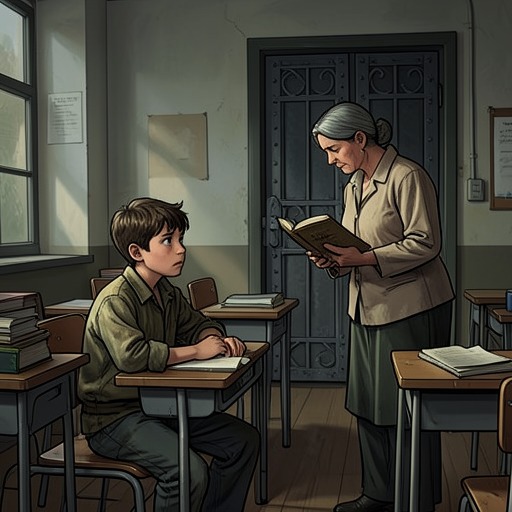
Jackie’s educational strategy begins with a concrete perception of danger. When Rob enters Oakdale Elementary School, the building appears orderly and the curriculum conforms to federal guidelines, but she senses that teachers and parents have adopted a laissez-faire attitude: many children are being sent there to be watched rather than taught. Her concern is not abstract ambition. She is trying to protect a gifted child from an environment whose low expectations may become permanent.
Her parents reject the idea of paying for private kindergarten. Rob is only six, they argue, and the family’s limited income should go first toward food, clothing, and shelter. Skeet Douglas adds a different objection by calling Jackie “uppity.” In the local vocabulary, the accusation means believing one deserves more than the people around him and might leave the neighborhood behind. Education therefore becomes socially charged before it becomes economically transformative. To seek the best school for Rob can look like a rejection of the community, a claim to superiority, or an attempt to escape the identity imposed by place.
For a time, Skeet prevails, and Rob attends Oakdale. The choice reflects competing definitions of development. Skeet believes that the boy must learn how to become a respected man among other men; Jackie fears that this training will displace the humanities, sciences, and habits of thought she associates with a genuine education. The disagreement is also shaped by Skeet’s drug trade and the family’s precarious housing. After the Pierson Street house burns and Skeet moves to an apartment on Chestnut Street, Jackie’s concern about security becomes inseparable from her concern about school. Rob’s future is being negotiated in a landscape where family income, criminal prosecution, housing, and education continually collide.
Jackie Peace’s Sacrifice
The turning point comes after Skeet’s arrest for the murders of Charlene Moore and Estella Moore. Rob is now officially growing up in a single-parent home, while his father waits in Essex County Jail and later faces the possibility of a death sentence. The situation exposes the limits of education as a public good. Oakdale’s neighborhood children face not only inadequate instruction but also the consequences of violence, poverty, and absent or imprisoned fathers. Rob’s defeats in math league and spelling-bee competitions against wealthier schools in South Orange and Montclair teach him that effort alone does not create equal footing; he and his classmates identify money as the missing element.
Jackie responds by converting her own labor into educational access. After Skeet’s arrest, she attends night school for six months to qualify as a kitchen supervisor. She sees Rob for less than an hour on many mornings, but the training leads to an administrative position at University Hospital and a $2,000 annual raise. She then takes a second job sweeping hair from a salon floor, cuts back on clothing, food, and luxuries, and saves for two years. The sacrifice is measured in ordinary details: Rob wears outgrown clothes, eats yellow rice with black beans on many nights, and is often alone or with his grandparents while Jackie works.
In September 1990, as Skeet’s murder trial begins, Rob enters fourth grade at a private Catholic school. The timing gives education a double meaning. Jackie is attempting to secure her son’s future while the state determines his father’s fate. Skeet is eventually released after the indictment is dismissed on speedy-trial grounds, but the years of imprisonment have already reshaped Rob’s childhood. School becomes one of the few institutions through which Jackie can act directly, even when the legal system and the family’s economic circumstances remain beyond her control.
Private School as an Opportunity Structure
The contrast between public and private education becomes sharper when Rob returns to Oakdale in eighth grade after Jackie loses her University Hospital job in 1993. The public school is more dangerous and more crowded than it had been when he was younger. Rob must spend energy avoiding being jumped or robbed, while classrooms may contain more than forty students and offer little new knowledge. Mt. Carmel Elementary School, by contrast, has only eighteen students per grade and a culture in which teachers and students appear to see beyond their immediate circumstances. Its tuition costs $200 a month, roughly a third of Jackie’s monthly salary, making the school a substantial but intelligible investment.
Jackie’s visit to Orange High crystallizes her fear. The school she once attended now appears to her as a place preparing students not for college or employment but for lives as loiterers, hustlers, and single mothers. She understands that she will probably remain in Orange, bound to its streets and its limited prospects, while Rob may leave through a sustained effort of schooling. Her vision of his departure is not merely geographic. It is a belief that education can interrupt the reproduction of the neighborhood’s expectations across generations.
The private high schools offer a narrow institutional bridge for a large population. Seton Hall Prep, the Immaculate Heart of Mary, Essex Catholic, and St. Benedict’s Prep together accept only about six hundred freshmen each year from roughly ten thousand teenagers in greater Newark seeking such opportunities. Admission requires tours, interviews, and entrance examinations, while financial aid determines who can actually use the opportunity. St. Benedict’s tuition is listed at $8,700 against an overhead cost of $16,000 per student, but its alumni network makes unusually generous aid possible. Rob’s eventual tuition is reduced to $4,000 a year, still requiring Jackie to manage a $500 down payment and monthly installments.
St. Benedict’s is not a simple escape into a wealthy world. By the time Rob arrives in 1994, the school has a pool, auditorium, sports complex, science wing, Apple IIc computers, and a six-thousand-book library, supported by Friar Edwin Leahy’s donor network. Yet its deeper mission is to free students’ cognition and potential from the emotional trauma produced by unstable home lives. The school’s modern equipment matters, but so does its attempt to create a setting in which students can imagine themselves beyond the limits of their streets. Rob’s admission thus represents both institutional generosity and the conversion of family sacrifice into cultural and academic capital.
From St. Benedict’s to Yale
At St. Benedict’s, education becomes measurable achievement. Rob earns high grades, develops leadership credentials, and helps build a record that includes a combined SAT score of 1510 out of 1600, placing him in the ninety-ninth percentile nationally. The college counselors advise him to apply broadly, including to top-tier universities. He initially regards the Ivy League tour as a free trip rather than a serious possibility, but the invitation itself enlarges the field of institutions in which he can imagine belonging.
Rob’s choice of Yale University marks the most dramatic educational ascent in the book. Jackie drives him ninety miles from Orange to New Haven with a television, a canvas duffel bag, a backpack of books, and a side table. The journey carries both exhilaration and fear: the family is entering a world signified by ancient buildings, crowded freshman residences, and more than a thousand other students whose material lives have been packed into cars. Before graduating from St. Benedict’s, Rob receives the Presidential Award, the school’s highest honor, confirming that the route Jackie purchased through sacrifice has produced genuine distinction.
At Yale, however, education does not erase the inequalities that brought him there. Rob’s classmates see the prep-school graduate, water-polo player, and Appalachian Trail hiker as a typical affluent and overeducated applicant, while much of his history remains invisible. His social and cultural mobility produces distance from the people who knew him in East Orange, but it does not provide a stable professional identity. Even in his senior year, when science students prepare for the MCAT and plan medical careers, Rob avoids the exam and changes the subject to Rio de Janeiro. His Yale degree gives him credentials, yet his immediate plans remain uncertain.
The book also reveals a darker conversion of education into resources. Rob has earned more than $100,000 selling marijuana at Yale. He gives some of the money to Jackie in installments small enough to be explained as dining-hall wages, spends approximately $10,000 on school supplies and summer travel, reserves another $30,000 for his mother, and holds the remaining “fifty large” for a trip to Rio and the year after graduation. Education has opened an elite institution, but the illicit economy finances the freedom that the institution alone cannot provide.
The Limits of the Educational Promise
After Yale, Rob’s trajectory exposes the difference between educational mobility and secure class mobility. In the summer of 2003 he has no job, no schoolwork, and suddenly no money. Most graduate-school applications were already due while he was in Rio, and he returns to Jackie’s house, eating her food and watching her leave for work. The return resembles the setbacks of relatives who had tried to leave Chapman Street and been forced back. His education has changed his capacities and expectations, but it has not guaranteed a next institutional step.
Rob briefly considers teaching at St. Benedict’s, where Coach Ridley recognizes that the position would function more as a stopgap than a career. His Yale science degree could, in theory, lead to work that paid more and offered greater flexibility. Instead, he later takes a baggage job at Continental Airlines. Jackie repeatedly points out the contradiction: he is a Yale graduate, scientist, and teacher, yet he is working at the lowest level of the airport, a position that does not require even a high-school diploma. Rob answers that a teacher’s salary would not allow him to make ends meet and that manual labor exchanges mental strain for physical strain. He frames the job as a path toward real estate and as a return to the straightforward goal of providing for oneself.
The gap between qualification and reward becomes a structural problem rather than a personal quirk. Rob’s résumé moves from laboratory research to high-school teaching, airport labor, and a controversial firing. When he later applies to pharmacies, real-estate firms, and a Merck plant, he recognizes that he is overeducated and underskilled. Each decision had made sense when he lived it, but on a single sheet of paper the sequence appears discordant. The very education that should certify him instead makes employers unsure where to place him, while his lack of conventional experience makes the credential difficult to convert into employment.
His real-estate plan encounters another institutional barrier. In the fall of 2007, the housing bubble bursts. Falling prices seem at first to create an opportunity, but the collapse of the subprime-lending market removes the financing on which Rob’s plan depends. Peace Realty remains limited to one property at 122 Greenwood Avenue. The episode demonstrates the central tension of Education as social mobility: knowledge, ambition, and willingness to work cannot by themselves overcome a credit system that withdraws access at the moment an educated but economically vulnerable entrepreneur needs it.
Rob’s later difficulty finding work confirms that education is a route, not a guarantee. Oswaldo Gutierrez advises him not to act above prospective jobs during interviews because interviewers can detect his lack of commitment. Rob finds the advice sensible but hard to accept. He can speak for hours with friends about the details of their lives, yet becomes bored during a twenty-minute interview. His Yale achievement remains real, but it does not automatically translate into the demeanor, networks, or job history that employers reward.
Significance
The concept therefore carries both hope and indictment. Jackie Peace’s sacrifices move Rob from a declining public school to Mt. Carmel, St. Benedict’s, and Yale; those institutions provide knowledge, mentors, athletic and scientific opportunities, leadership recognition, and access to worlds far beyond Orange. Education genuinely expands his horizon. It helps him leave the neighborhood for Yale, and it gives him the intellectual resources to imagine scientific work, teaching, travel, and real estate.
But the book refuses to treat mobility as a one-way ascent. Rob’s father’s arrest for murder, the years of incarceration, the family’s unstable finances, racialized urban geography, and the collapse of legitimate employment opportunities remain active forces. Rob can cross institutional boundaries without becoming fully secure in any of the social worlds he enters. He is too accomplished to fit comfortably into some local expectations, yet too disconnected from elite professional pathways to convert achievement into stability. His education becomes a form of cultural capital that repeatedly encounters limits when it must be exchanged for money, housing, credit, employment, or recognition.
The final irony is that the educational promise survives even when Rob does not. His body is found facedown in the basement of the Smith Street house, blood pooling beneath him, while the trajectory that began with Jackie carrying a newborn home from St. Mary’s Hospital ends in violence. The outcome does not prove that schooling was meaningless; it shows instead that individual educational ascent cannot by itself dissolve the structures surrounding a life. Education gives Rob distance, language, and possibility, but the book’s tragedy lies in the forces that continue to claim him after he has learned how far he might go.